
Search Washington County Felony Records
Washington County felony records include arrests, criminal charges, and court outcomes for serious crimes. The Circuit Clerk in Chatom stores all felony case files. These records are public and open to anyone. Washington County is in southwest Alabama, one of the state's oldest counties. This page covers how to access felony records in Washington County.
Washington County Quick Facts
Washington County Circuit Clerk
The Circuit Clerk handles all felony court records in Washington County. This office processes filings, stores documents, and assists with searches. The office is at the Washington County Courthouse in Chatom. Staff can help you find felony records during regular business hours.
Washington County belongs to the 1st Judicial Circuit along with Clarke and Choctaw counties. The Circuit Court hears all felony cases. When someone faces serious charges in Washington County, the case goes to this court. The clerk assigns a case number and tracks all activity. Every motion and ruling becomes part of the public record.
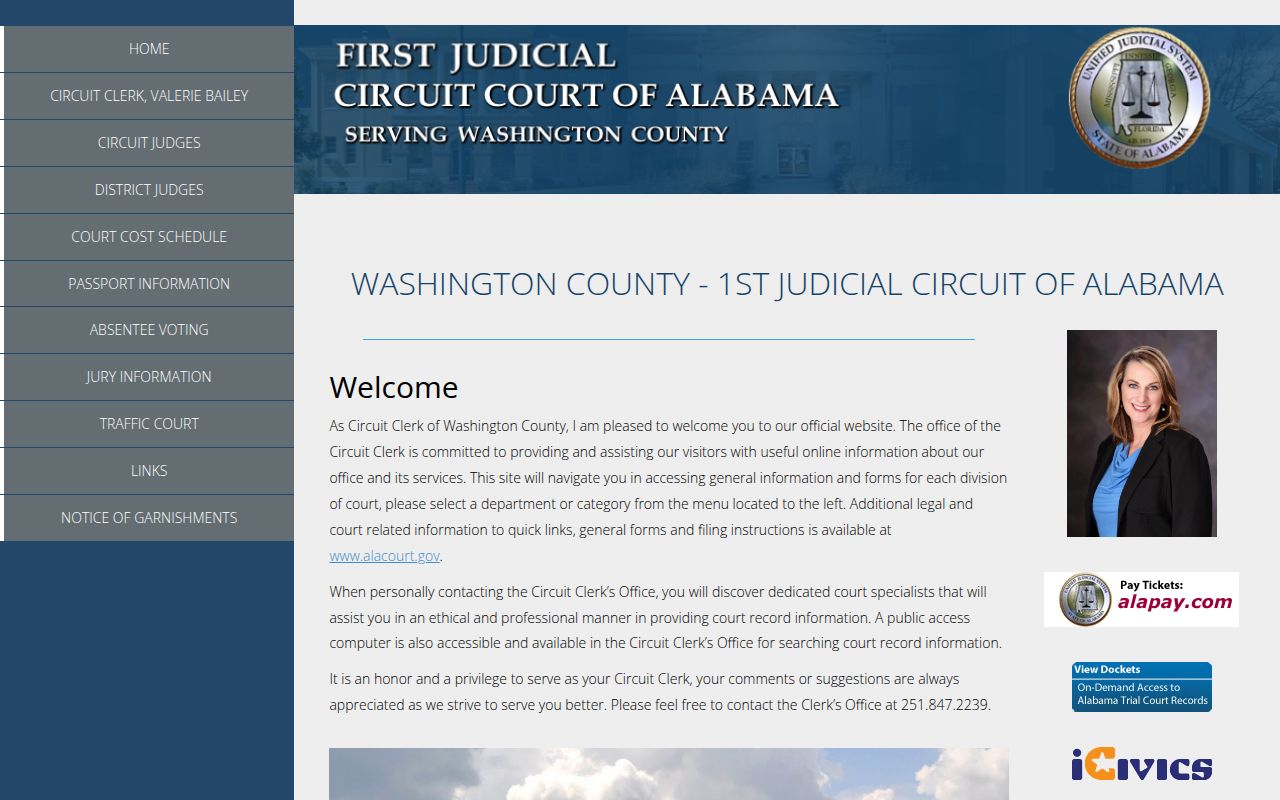
| Office | Washington County Circuit Clerk |
|---|---|
| Address | P.O. Box 549, Chatom, AL 36518 |
| Phone | (251) 847-2208 |
| Hours | Monday through Friday, 8:00 AM to 5:00 PM |
| Website | washington.alacourt.gov |
How to Search Washington County Felony Records
Searching felony records in Washington County can be done online or at the courthouse. Online is fast and works from home. In-person visits give full file access. Both options work for public records.
Use Alacourt ACCESS for online searches. Select Washington County and enter a name. Results show matching cases. Each search costs $9.99. You see charges, dates, and outcomes. Document images cost extra. The site is available 24/7 for Washington County searches.
To search in person, go to the courthouse in Chatom. The Circuit Clerk's office is inside. Staff search by name or case number. You can review files and request copies. Bring your ID. Copy fees apply per page. Call ahead for old records from Washington County.
What you need for a search:
- Full name of the person
- Date of birth if known
- Year of the arrest or charges
- Case number if available
Washington County Sheriff's Office
The Sheriff's Office makes arrests and operates the county jail. Deputies respond to felony crimes. They book suspects into jail and set initial charges. The sheriff maintains arrest records with booking info and bond amounts.
For current jail information, call the sheriff. Staff can tell you about inmates. Bond amounts are available by phone. Washington County does not have an online jail roster. You must call for inmate details. Court records go to the Circuit Clerk after formal charges are filed in Washington County.
| Office | Washington County Sheriff's Office |
|---|---|
| Address | Chatom, AL 36518 |
| Phone | (251) 847-2211 |
Online Access for Washington County
Washington County court records are on the Alacourt system. This state portal covers all 67 Alabama counties. Criminal cases, including felonies, are searchable. The system charges a fee but is open to anyone.
The Alabama Department of Corrections has free inmate searches. It shows people in state prison. If someone from Washington County is serving time, you can find them here. Enter a name or AIS number. Results show facility and sentence info. County jail inmates are not included.
ALEA has the official criminal history database. The Alabama Law Enforcement Agency keeps records for all state arrests. This is not public. You can get your own record for $25 with fingerprints. For court records, use Alacourt for Washington County.
What Washington County Felony Records Show
Felony records from Washington County have complete case information. Each file documents the criminal case from arrest to resolution. The format is standard across Alabama.
A Washington County felony record shows:
- Defendant's name and date of birth
- Arrest date and arresting agency
- Charges with felony class
- Court hearing dates
- Motions and rulings
- Plea or trial verdict
- Sentence if convicted
- Bond amounts and status
Under Code of Alabama Section 13A-5-6, felony sentences vary by class. Class A is 10 years to life. Class B is 2 to 20 years. Class C brings up to 10 years. Class D caps at 5 years. Washington County records show the class for each charge.
Washington County Felony Laws
Court records are public in Washington County. Under Code of Alabama Section 36-12-40, everyone can inspect public records. Felony case files are covered. You can view or copy them. No reason is needed to make a request.
Some records are restricted. Juvenile cases are sealed. Cases a judge ordered sealed are off limits. Expunged records do not show. But adult felony cases in Washington County are open to the public.
Misusing records has penalties. Under Code of Alabama Section 41-9-601, obtaining records fraudulently is a felony. Fines go from $5,000 to $10,000. Prison can reach five years. Only use Washington County records for lawful purposes.
Expungement in Washington County
Some felony records may be sealed in Washington County. The process is called expungement. State law defines who qualifies. Not every case can be expunged. If you meet the criteria, you can petition the court.
Under Code of Alabama Section 15-27, dismissed charges may qualify. Acquittals can be erased. If you got a pardon with civil rights restored, some convictions may be eligible. Violent felonies have strict limits.
To start expungement in Washington County, file a petition with Circuit Court. The clerk handles the filing. A judge reviews and decides. If granted, records are sealed from public searches. Visit ALEA expungement info for forms.
Contact Information
Reach Washington County offices using the contacts below. Call to check hours and what you need for your search.
| Washington County Circuit Clerk | (251) 847-2208 |
|---|---|
| Washington County Sheriff | (251) 847-2211 |
| ALEA Criminal Records | 1-866-740-4762 |
| ADOC Inmate Info | 1-855-WE-R-ADOC (1-855-937-2362) |
Nearby Counties
These counties border Washington County. Check where the crime occurred to find the right records. Each county has its own court files.